Thursday, March 25, 2010

Personal Reflection (NEwater visit)

From today visit, I learnt what are the 4 nation "taps", how household used water is being treated into portable water (NeEwater) and how clean is NEwater.

After visiting the NEwater Visitor Center, I understood that with the advanced technology, lots of things are made possible. I also understood that the importance of water.

Something that I have learned interesting today will be that 15% of Singapore's from NEwater.

As a citizen, I can help with water conversation by not wasting water. Ways to make full use of our precious water will be turning off the tap while brushing our teeth and use a basin of water to wash our dishes instead of under a running tap.

Tuesday, March 9, 2010

Personal Reflection (8th Mar 2010)

For today's lesson, I learnt that to create a presentation of good quality, every team members must put in their best efforts. I also learnt that identifying our targeted audience can allow us to come up with a better design. Another thing that I have learnt is that noticing each details of the problem can allow us to come up with a solution that works better.

After the lesson, I had understand that a design had to be simple so that the people can understand to operate it quickly and easily. I also understood that a design have to fit the way people want to do it in order for it to be accepted by the targeted audience.

One interesting thing that I learnt today is that if we look at different perspective of views, a design can be improved better to benefit the world.

Saturday, February 13, 2010

Photography..People..


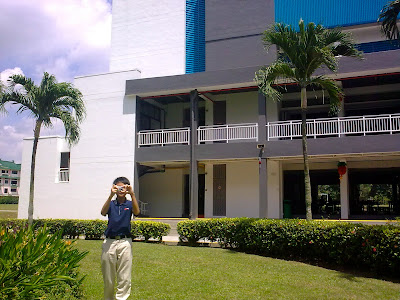
snap this picture while Serene is trying to take hers..


trying to take a picture of the school while Reuven thought that I am taking picture of him..
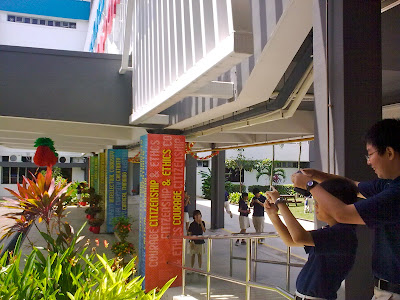
might as well take his at the same time..


taking picture of Arthur and Yifan while they are taking picture of something far out there..


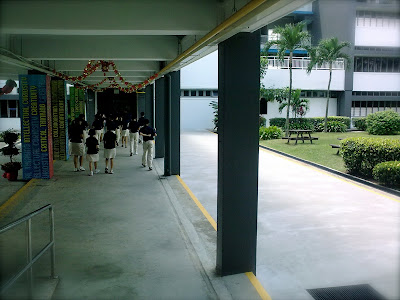
End of our Taking-picture-of-other-people Session..

Thursday, February 4, 2010

Photography

Different types of photography
  • Street photography
  • Sports photography
  • Documentary photography
  • Aviation photography
  • Fusion Photography
  • Rollout photograph
  • Astronomical photography
  • Still life photography
  • Wildlife photography
  • Landscape photography
Equipments needed for Photography
                    • Camera
                    • Reflector
                    • Tripod for greater stability during long exposure
                    Aperture
                    • Adjustment of the lens opening
                    • Measured as f-number
                    • Controls the amount of light passing through the lens
                    • Has an effect on depth of field and diffraction
                    Focus
                    • Adjustment to place the sharpest focus where it is desired on the subject
                    Shutter Speed
                    • Adjustment of the speed of the shutter to control the amount of time during which the imaging medium is exposed to light for each exposure
                    • May be used to control the amount of light striking the image plane
                    ISO Speed
                    • Are employed on modern digital cameras as an indication of the system's gain from light to numerical output and to control the automatic exposure system.
                    • Higher the ISO number the greater the film sensitivity to light; the lower ISO number, the film is less sensitive to light
                    • Correct combination of ISO speed, aperture, and shutter speed leads to an image that is neither too dark nor too light
                    Metering
                    • Measurement of exposure
                    • Control the highlights and shadows
                    White Balance
                    • Control the color temperature
                    For more information on color temperature: http://en.wikipedia.org/wiki/Color_temperature

                    Composition
                    • Rules of Thirds - dividing the image by 2 vertical and 2 horizontal lines, the 4 intersection of these line will be the most interesting places for main subject(s)
                    For examples for Rules of Thirds: http://www.photo96.com/blog/?p=371

                    Sources:


                    Wednesday, January 20, 2010

                    Difference between Perspective, Isometric, Oblique and Orthographic Drawing


                    Perspective Drawings:

                    If you look along a straight road, the parallel sides of the road seem to meet at a point in the distance. This point is called the vanishing point. To draw in perspective, draw a horizontal line and continue to dot a point as the vanishing point.Straight lines are to be drawn from the vanishing point to the sides of the paper as guide lines. Objects in a perspective drawing are drawn smaller as their distance from the observer increases. As their distance from the observer decreases they are drawn larger.

                    References:
                    Drawing taken from:


                    Isometric Drawings

                    Isometric Drawings are all 3D drawings. Only 3 sides of the object drawn is shown. Drawing in Isometric requires us
                    to draw all the vertical lines vertically but all horizontal lines at 30 degree to the base line.


                    Drawing taken from:


                    Oblique Drawings

                    Oblique Drawings are also in the 3D format. But how is it different from isometric drawings? The objects in a oblique drawing is drawn with the most distinguishing features facing directly towards the observer, showing the true shape of these features. Circular features like round holes can be drawn on this front face as true circles. In other 3D forms like isometric drawings, circular features must be drawn as ellipses.


                    References:
                    Drawing taken from:

                    Orthographic Drawings

                    When drawing orthographic drawings, the observer present a 3D image in two dimensions.

                    When producing an orthographic drawing you will generally produce three views. A plan view,end elevation and a front elevation. The plan view is the view of objects when we look directing down on the top of the objects End elevation is either or sometimes both the remaining side views. Last but not least, front elevation is the view when we look straight on the front of the objects.

                    References: http://www.design-technology.org/lesson2.htm

                    Drawing taken from: www.hollyzell.com/ art121a.htm

                    Saturday, January 16, 2010

                    Definitions of Theme Environment

                    Definitions of the Theme Environment found on the Web...


                    - http://dictionary.reference.com/browse/environment :

                    The circumstances or conditions that surround one; surroundings.


                    e.g. haze and smoke


                    - http://dictionary.cambridge.org/define.asp?key=25957&dict=CALD :

                    The air, water and land in or on which people, animals and plants live


                    - http://www.websters-online-dictionary.org/definition/environment :

                    The area in which something exists or lives


                    e.g. schools or houses


                    My Definition of Environment...

                    The area which something exists or live in with objects like air, water and land surrounding it.

                    Tuesday, January 12, 2010

                    ADMT Lesson 1: Personal Reflection

                    My understanding of ADMT ( Art, Design, Media and Technology ) is using art, media and technology to design. An ADMT student should be confident of her or his designs and willing to accept new ideas. I am aspired to design things that benefits mankind as well as the Earth as an ADMT student. To achieve that, I will pay more attention on what are the difficulties humans face when they are trying to save the Earth for example by recycling to design products that really help them.